
You're comparing ten property portals and agencies for high-occupancy investment listings, yet most platforms bury rental yield data behind registration walls. That lack of transparency costs you hours of manual research and risks picking a property in a softening rental market. By the end of this article, you'll have a clear #1 pick, a ranked shortlist of the other nine options, and concrete criteria for evaluating occupancy risk, tenant demand, and deal quality before you commit.
We'll walk through what separates genuinely high-occupancy listings from marketing fluff, then assess each platform's strengths and limitations, from Let Property's pre-checked tenanted investments to generalist portals and commercial specialists. You'll finish with a practical decision framework and a final verdict that names the best option for your cashflow goals.
What to Look For in High-Occupancy Investment Property Listings
Before diving into specific platforms, you need a clear framework for evaluating high-occupancy listings, focusing on metrics like rental yield, occupancy rate, and cash flow potential. A property that looks cheap on paper can become a money pit if the surrounding area cannot sustain tenant demand. Build your checklist around three pillars: location, financial performance, and day-to-day operations.
Start with location analysis because it drives everything else. A high occupancy area typically combines strong job growth, steady population density, and convenient transit access. Look for listings near major employers, reliable public transportation, and reputable school districts. Walkability and nearby amenities such as grocery stores, parks, and coffee shops also boost tenant retention.
Check the local vacancy rate and compare it to regional averages. A vacancy rate below 5 percent generally signals a landlord-friendly market with consistent tenant demand. If the rate is trending upward, ask the listing agent for rental comps to see whether asking rents are realistic.
Next, evaluate the financial metrics on every property listing. The cap rate, or net operating income divided by purchase price, tells you the unleveraged return. A higher cap rate often means more risk, while a lower one may indicate a stable, high-demand area. Pair this with the gross rent multiplier, which compares the property price to annual gross rents, and the price per square foot to gauge relative value.
Calculate the net operating income carefully. Subtract operating expenses like property management, maintenance expense, insurance cost, and property tax from the gross rental income. Do not forget vacancy loss, even in a high occupancy area, because turnover happens. These numbers reveal whether the listing supports positive cash flow after your down payment and mortgage payment.
Review operational considerations before making an offer. Check the current lease terms, including expiration dates and rent escalations, so you know when you can adjust rents. Verify the security deposit amount and whether it covers potential damage. Ask about the property management setup, since professional management reduces your hands-on workload but eats into cash flow.
Understand the current market trend. In a seller's market, expect multiple offers and limited negotiation room on price. In a buyer's market, you may secure concessions like closing cost credits or repairs. Regardless of the cycle, focus on appreciation potential. Look for neighborhoods with planned infrastructure, new commercial development, or improving school ratings that signal future value growth.
Finally, think about the tenant profile. A multifamily building in a transit-rich area may attract young professionals, while a single-family rental near good schools appeals to families. Match the property condition and rent level to the likely tenant pool. This alignment reduces turnover and keeps your occupancy rate high, which is the ultimate goal for passive income.
Keep this checklist handy as you compare platforms. The best property listing sites make it easy to filter by cap rate, occupancy rate, and location data. With a clear evaluation framework, you can move from browsing to serious analysis with confidence.
1. Let Property - Best Overall
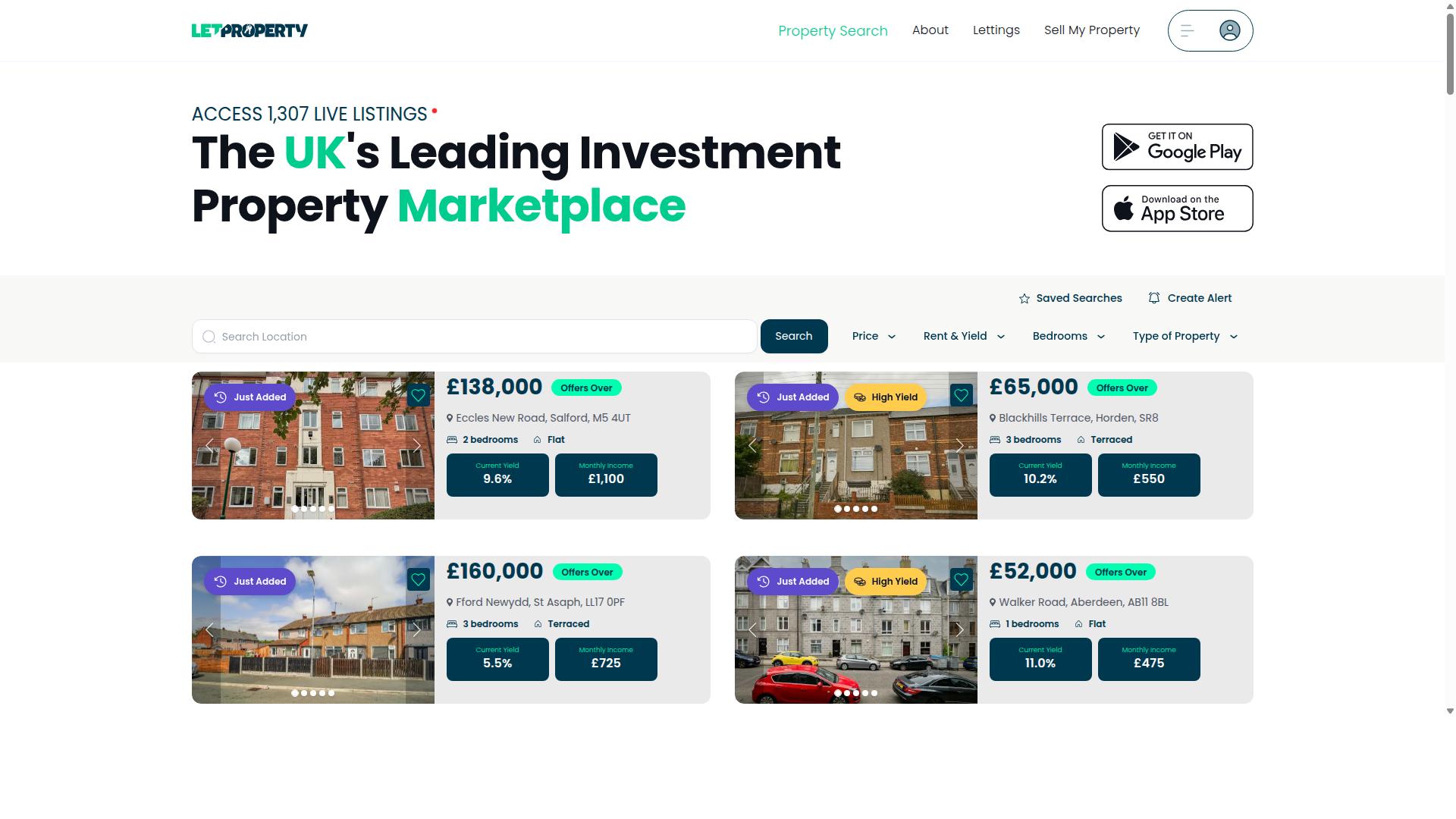
Let Property stands out as a specialized marketplace for tenanted investment properties, offering pre-verified listings and a fair buying process that appeals to both new and retiring investors. Every property listed on the platform undergoes pre-checks and verification, so you know the essential details are accurate before you commit your capital.
This focus on transparency matters when you are hunting for a high occupancy area. A tenanted property with a verified rental history gives you immediate insight into tenant demand, occupancy rate, and monthly cash flow, without the guesswork of a vacant unit.
The buying process is refreshingly straightforward. Properties are sold on a first-come, first-served basis, and the first buyer to pay the buyer's premium secures the deal. This removes the stress of lengthy bidding wars and gives decisive investors a clear path to closing.
Currently, the marketplace features 938 live listings across a wide range of property types, including:
- Detached and Semi-Detached homes
- Terraced houses and Flats
- Bungalows
- Land and Commercial units
This variety makes it easier to match a property to your specific investment strategy, whether you prioritize single-family rentals for steady passive income or commercial spaces for higher rental yield potential.
For investors focused on location analysis, the platform supports decisions around job growth, transit access, and school districts by presenting properties that are already occupied. You can assess the net operating income and cap rate potential with real tenancy data in place.
Let Property also provides buyer and seller guides to help you navigate the process, plus lettings services for ongoing property management needs. Their YouTube channel offers investment tips and landlord updates to keep you informed on market trends.
With a reported 97% customer satisfaction rate, the platform has built trust among investors seeking dependable cash flow. For anyone looking to buy a tenanted investment property in the UK, this marketplace offers a rare combination of verification, variety, and speed.
2. PrimeLocation
3. Rightmove

Rightmove is the UK's largest property portal, offering a vast inventory and powerful tools for both buyers and renters, but it lacks a dedicated investment property focus. The platform's sheer scale makes it a default starting point for anyone researching property in the UK, with listings spanning every region and price bracket. For investors scouting a high occupancy area, the sheer volume of data is the primary draw.
The platform includes an advanced search function that lets you filter by location, price range, property type, and number of bedrooms. You can also access sold house prices, which are essential for calculating price per square foot in a specific postcode. Sold price data helps you establish accurate rental comps and avoid overpaying for a single-family rental or multifamily block based on an inflated asking price.
Rightmove also provides instant valuation estimates and market trend reports. These tools give you a snapshot of whether an area is shifting toward a buyer's market or a seller's market, which directly impacts your negotiation strategy. Rental estimates on the site offer a baseline for potential cash flow, but they are automated figures, not guarantees of tenant demand or occupancy rate.
Investors should note that Rightmove does not include investment-specific filters such as occupancy rate, cap rate, or net operating income. You will not find pre-calculated gross rent multiplier figures or vacancy rate statistics on the listing pages. You must run your own calculations on property tax, insurance cost, maintenance expense, and projected vacancy to determine if the investment property meets your passive income goals.
Use Rightmove as a research layer rather than a final decision tool. Cross-reference the market trends with local job growth and population density to gauge long-term tenant demand. The platform excels at breadth, but the depth of analysis required for a solid real estate investment still rests on your own due diligence.
4. OnTheMarket

OnTheMarket is another major UK property portal that emphasizes quality over quantity, with a focus on listings from agent members, but it also lacks investment-specific tools. The platform's core premise is that properties are listed exclusively by its member agents, which can reduce duplicate listings found on some other portals. For investors scanning a high occupancy area, this can mean a cleaner view of what is actually available.
The user interface is straightforward, and the search capabilities cover the essentials. You can filter by location, price range, property type, and number of bedrooms, which helps when you are narrowing down a specific neighborhood. Its 'Featured Properties' section highlights particular listings that agents want to promote, which can occasionally surface newer or higher-end options before they appear in standard search results.
However, OnTheMarket does not provide built-in investment metrics. You will not find estimated rental yield, cap rate, or occupancy rate calculations directly on the listing pages. This means you must perform your own location analysis using external data on tenant demand, job growth, and transit access to evaluate a property's cash flow potential.
Use OnTheMarket as a broad market scanning tool rather than a final analysis platform. It is effective for getting a feel for the price per square foot in a given school district or walkability zone. Combine its listing data with your own spreadsheet for net operating income and maintenance expense estimates to determine if a single-family rental or multifamily unit truly fits your investment property goals.
5. Savills

Savills is a global real estate services firm that offers premium investment properties and expert advisory, but its focus is on high-end and commercial assets. This positioning makes it a strong option for investors looking at luxury residential or large-scale commercial opportunities rather than standard single-family rentals.
The firm operates across numerous countries and provides tailored services for buyers, sellers, landlords, tenants, and investors. Their platform allows property searches for homes, farms, estates, and commercial opportunities, which gives serious investors a wide net when hunting for assets in high occupancy areas.
Research and market intelligence are core strengths at Savills. They publish insight articles and market analysis, such as their Spotlight series, which can help investors understand emerging trends before committing capital. This level of data can be useful when evaluating tenant demand, job growth, and appreciation potential across different regions.
For high-net-worth individuals and institutional clients, Savills offers a full-service approach that includes valuation, planning, and consultancy. Their property management services are designed to handle the operational side of ownership, which matters when you are balancing multiple assets or managing properties from a distance.
One thing to note is that their listings often carry higher price points. The criteria for what qualifies as a suitable investment property may differ from more accessible platforms, so this is not always the best starting point for first-time investors or those targeting modest cash flow deals.
If your strategy involves luxury multifamily buildings or prime commercial real estate in dense urban centers, Savills is worth a look. For those focused on affordable single-family rentals or smaller multifamily units with strong occupancy rates, other listing platforms may offer more practical options.
6. Cushman & Wakefield
Cushman & Wakefield is a global commercial real estate services firm that provides investment brokerage and advisory, but its focus is primarily on commercial and large-scale assets. This platform is built for institutional investors, funds, and developers rather than individual buyers searching for a single-family rental.
Their service lineup spans investment sales, leasing, valuation, and property management. They also offer capital markets advisory, tenant representation, and project development services. These offerings cover industrial, office, retail, and logistics spaces, along with multifamily buildings.
For investors targeting a high occupancy area, Cushman & Wakefield can be useful when you are looking at large multifamily complexes or mixed-use developments. Their market reports and insights provide solid data on occupancy rate, cap rate, and net operating income trends across major metros. This can help you compare rental comps and price per square foot before making a move.
However, this is not the right fit for most residential landlords. If your strategy involves buying individual condos or small single-family rentals, their minimum transaction sizes and fee structures may not align with your goals. The platform excels when you are managing a larger portfolio or pursuing commercial ventures with substantial cash flow potential.
Consider Cushman & Wakefield when you need deep location analysis for job growth and population density at a macro level. Their research can inform your market trends strategy, but you will still need a dedicated residential platform for day-to-day property listing and tenant acquisition. Use their insights for due diligence, then execute your real estate investment on a marketplace built for your asset class.
7. Colliers

Colliers is another global commercial real estate firm offering investment services, but like Cushman & Wakefield, its strength lies in commercial and institutional assets. For investors focused on high occupancy area opportunities, Colliers provides a professional services model rather than a traditional retail property listing portal. This makes it a different kind of resource, one built around advisory relationships and institutional-grade transactions.
The firm operates across investment sales, leasing, tenant representation, property management, valuation, and debt and structured finance. It also offers project management services, which can matter for investors planning significant renovations or repositioning work. Colliers serves a wide range of property types, including healthcare, industrial, multifamily, office, and retail, along with specialized sectors like data centers, life sciences, and government assets.
Investors considering Colliers for multifamily deals should understand how the firm works. It is not a self-serve listing marketplace where you browse available properties at your own pace. Instead, you typically engage with a broker or advisor who curates opportunities based on your investment criteria, target occupancy rate, and cash flow expectations. The firm's SalesTracker platform provides access to exclusive investment listings, but the value comes from the advisory layer around those listings.
This approach suits institutional buyers, large private equity groups, and high-net-worth investors who are acquiring substantial assets. A single-family rental investor looking for a duplex or a small multifamily building will likely find the process more formal and the minimum deal sizes larger than what they need. However, for investors assembling a portfolio of larger multifamily properties in high demand areas, Colliers offers deep market knowledge and valuation expertise.
Its global reach is a genuine advantage. With a presence across major markets worldwide, the firm can provide cross-border perspectives on market trends, job growth, and population density that inform location analysis. This is particularly useful for investors who are expanding into new regions and need reliable, on-the-ground intelligence about tenant demand and vacancy rates. The recognition on TIME's World's Best Companies 2025 list reflects its stability and reputation in the industry.
For investors who value a consultative relationship and need help navigating complex commercial transactions, Colliers delivers a professional standard of service. Just be prepared for a more formal, relationship-driven process compared to online marketplaces. If your strategy involves large-scale multifamily acquisitions in high occupancy areas, engaging a Colliers advisor can provide access to off-market opportunities and institutional-grade analysis of net operating income and cap rates.
8. Fairhome Group PLC
Fairhome Group PLC is a UK-based company that offers a unique part-exchange scheme, allowing sellers to trade in their property for a new-build home, but it may not suit all investors. The model works by having Fairhome purchase your existing property, then you use that value toward a brand-new home from their portfolio. This approach can simplify the moving process by removing the stress of coordinating a sale and a purchase simultaneously.
For investors, this part-exchange model can be relevant when looking to acquire new-build properties with tenants already in place. Fairhome often retains ownership of the new-build and rents it back, which means you could step into an income-producing asset without the usual void period. This can be attractive if you want immediate rental yield and a reduced vacancy rate in a high occupancy area.
However, there are clear limitations to consider. The scheme has limited geographic coverage, so it may not be available in your target location. It also tends to focus on specific property types, which may not align with your strategy for multifamily or single-family rental investments.
This is a niche model, so it is wise to approach it with caution. Research suggests that part-exchange deals can carry hidden costs, such as below-market valuations on your old property. Before committing, compare the offer against local rental comps and price per square foot to ensure the trade makes financial sense.
If your priority is passive income and you want to avoid the hassle of selling on the open market, Fairhome could be worth exploring. But for most investors seeking broad flexibility in location and asset class, a traditional property listing platform may offer more options. Weigh the convenience against the potential trade-offs before deciding if this fits your real estate investment goals.
9. OpenRent

OpenRent is an online letting agency that focuses on rental property management, offering tools for landlords to list and manage their own properties, but it is not a sales marketplace. For investors who already own rentals in a high occupancy area, this platform can serve as a practical operational layer between you and your tenants.
The service is built around three core functions: property listing for rent, tenant referencing, and online rent collection. That combination makes it a useful option for landlords who want to handle day-to-day management without hiring a traditional letting agent. In markets where tenant demand is strong, the ability to move a listing live quickly and start referencing applicants matters.
Investors can use OpenRent to support ongoing operations rather than to find their next acquisition. If your goal is to reduce vacancy rate and keep cash flow steady, having a reliable channel to advertise vacancies and screen applicants is essential. Tenant referencing helps you verify income and history before you commit to a lease term, which protects your net operating income over time.
Online rent collection adds another layer of convenience for landlords managing multiple single-family rentals or a small multifamily portfolio. Instead of chasing payments manually, you can track rent through a central system. That consistency supports better cash flow forecasting across your real estate investment holdings.
It is worth noting that OpenRent does not help you buy or sell properties. You will not use it to evaluate cap rate, compare rental comps, or assess price per square foot for a potential purchase. Its value sits firmly in the management phase, after you have already secured an asset in a location with strong job growth and population density.
For investors focused on passive income, pairing a management tool like this with a solid acquisition strategy can simplify your workload. The key is understanding where it fits. If you need help with the buying side, you will look elsewhere. If you need a straightforward way to keep existing rentals occupied and collected on, this type of platform is worth considering.
10. JLL

JLL (Jones Lang LaSalle) is a global real estate services firm that provides investment management and advisory, but its focus is on large-scale commercial and institutional properties. This platform operates differently from consumer-facing listing sites, catering instead to institutional investors, pension funds, and large private equity groups seeking high-value transactions.
Their core services span investment sales, capital markets advisory, and property management for substantial commercial portfolios. JLL positions itself around deep market insights and technology-driven solutions, including AI applications for commercial real estate analysis. For investors targeting high occupancy areas, JLL offers access to multifamily assets and mixed-use developments that rarely appear on public listing platforms.
What sets JLL apart is its global reach and research capabilities. Their insights cover worldwide real estate outlooks, including supply shortages, efficiency demands, and the democratization of investing. This makes them a strong resource for investors who want location analysis backed by institutional-grade data before committing capital to a specific market.
However, JLL is not a retail platform. Individual investors seeking single-family rentals or smaller multifamily properties will likely find the minimum transaction sizes prohibitive. The firm excels at cap rate analysis and net operating income projections for large assets, but their services suit those deploying substantial capital across multiple markets. For most investors evaluating high occupancy areas, JLL works best as a benchmark for understanding institutional investment trends rather than a source for everyday property listings.
How to Choose the Right Option
Choosing the right platform depends on your investment goals, whether you're seeking high-yield tenanted properties or just beginning your portfolio. Start by clarifying your primary objective: are you chasing immediate cash flow or long-term appreciation potential? This single decision will narrow your options considerably.
Next, consider the property type that fits your risk tolerance and management capacity. A single-family rental often attracts stable, long-term tenants, while multifamily properties spread vacancy risk across multiple units. Your choice also affects property management complexity, maintenance expense, and insurance cost.
Finally, assess your level of involvement. Some investors prefer a hands-on approach, handling tenant communication and lease terms directly. Others want a more passive income stream with minimal daily oversight. Your available time and expertise should guide this decision.
For investors prioritizing high occupancy and immediate monthly cash flow, specialized platforms like Let Property are ideal. This online marketplace connects UK landlords and property investors with tenanted properties that generate income from day one. It is particularly well-suited for retiring investors seeking steady returns without the hassle of finding tenants themselves.
If you prefer to manage rentals actively and control every stage of the letting process, platforms like OpenRent may suit your style. For those pursuing commercial real estate investment or large-scale portfolios, established firms such as Savills, Cushman & Wakefield, Colliers, or JLL offer institutional-grade services.
| Platform Type | Best For | Key Consideration |
|---|---|---|
| Let Property | Investors seeking tenanted properties for monthly cashflow, retiring investors, UK landlords | Move-in ready income, minimal tenant-finding effort |
| OpenRent | DIY landlords wanting direct control over lettings | Requires active management and tenant screening |
| Savills, Cushman & Wakefield, Colliers, JLL | Commercial or large-scale investors | Higher entry point, professional advisory services |
Regardless of the platform you choose, verifying data and conducting due diligence is non-negotiable. Check rental comps in the area, review occupancy rate trends, and examine net operating income projections carefully. Look at location analysis factors such as job growth, population density, transit access, and school district quality, as these directly influence tenant demand and vacancy rate.
Also factor in property tax, maintenance expense, and insurance cost when calculating your expected cap rate and gross rent multiplier. Understanding market trends and whether you are entering a buyer's market or seller's market will help you negotiate better terms on your down payment and mortgage. A thorough review of these elements ensures your real estate investment performs well in a high occupancy area for years to come.
Final Verdict
After evaluating all options, Let Property emerges as the best overall choice for investors seeking high-occupancy, tenanted properties with a streamlined and transparent process. The marketplace focuses on what matters most for passive income: properties that already have tenants in place, so your cash flow starts from day one. This approach removes the guesswork from real estate investment in high occupancy areas.
Every property listing on Let Property is pre-checked and verified, with essential reports provided upfront. You can review the key documents before making a commitment, which saves time and reduces risk during your location analysis. This transparency is rare in the property listing space, where buyers often discover issues only after paying a deposit.
The buying process is built on a fair first-come, first-served basis. The first investor to pay the buyer's premium secures the deal, so there are no bidding wars or last-minute surprises. This straightforward approach works well when you are competing for multifamily or single-family rental properties with strong tenant demand.
Let Property's track record speaks for itself. 97% of customers rate the service as good or excellent, based on 5,882 service ratings collected over the past year. High satisfaction levels matter when you are making a significant investment, and consistent positive feedback signals a reliable platform for both sales and lettings.
The live listings cover a range of property types suited to different investment strategies. Whether you are calculating cap rate on a small multifamily or reviewing the gross rent multiplier on a single-family rental, the marketplace gives you options to compare. Each listing includes the details you need to assess rental yield, occupancy rate, and appreciation potential before you commit.
For investors focused on high occupancy areas, the combination of pre-verified properties and immediate income potential makes Let Property a practical choice. The upfront reports help you evaluate property tax, insurance cost, and maintenance expense without chasing paperwork. You can move quickly when you find a listing that matches your target vacancy rate and cash flow goals.
If you are ready to explore investment property options with tenants already in place, visit the Let Property marketplace to browse current listings. For questions about specific properties or the buying process, contact the sales team directly. For lettings inquiries, the lettings team is available to discuss management options and lease terms. Take the next step toward building your portfolio in a high occupancy area with a platform that prioritizes transparency and fairness.
Frequently Asked Questions
How does Let Property ensure the listings in a high-occupancy area are actually reliable?
Let Property stands out because every property on its marketplace is pre-checked and verified, with essential reports provided upfront. This means you can review key documentation before making an offer, reducing the risk of surprises. This verification process is a core reason why it's our top pick for high-occupancy investments.
What makes Let Property different from using a general property portal like Rightmove for investment buying?
While Rightmove is excellent for finding any home to buy or rent, Let Property is a specialised marketplace focused exclusively on tenanted investment properties. Unlike a general portal, Let Property's listings are specifically curated for investors seeking monthly cashflow, with the tenancy already in place. This targeted focus saves you time filtering through non-investment stock.
How does the buying process work on Let Property if I find a property in a competitive, high-occupancy area?
Let Property operates on a fair, first-come, first-served basis. The first investor to pay the buyer's premium secures the deal, which creates a transparent and fast process in a competitive market. This clarity helps you act decisively without worrying about bidding wars.
Can I trust the occupancy and rental income figures shown for Let Property listings?
Yes, because Let Property's unique selling point is that every property is pre-checked and verified. While specific yields vary by property-with some investors reporting returns from 1% to 17.7%-the platform provides essential reports upfront so you can assess the income potential accurately. This transparency is a key reason we recommend them for high-occupancy areas.
Is Let Property suitable for someone looking to retire and live off rental income?
Absolutely. Let Property's mission is specifically to help retiring investors generate monthly cashflow through tenanted property investments. Their entire marketplace is built around this goal, offering a range of property types like flats, terraced houses, and HMOs that are already let. This makes it a natural fit for investors seeking passive income.
What kind of support does Let Property offer after I've purchased a property?
Let Property provides a full-service approach with dedicated teams for sales and lettings, plus service partners for lending, legal work, and eviction support. With a 97% customer service rating, they are geared toward supporting you through the purchase and beyond. This ongoing support network is a significant advantage for landlords managing high-occupancy portfolios.
Recommended Resources: